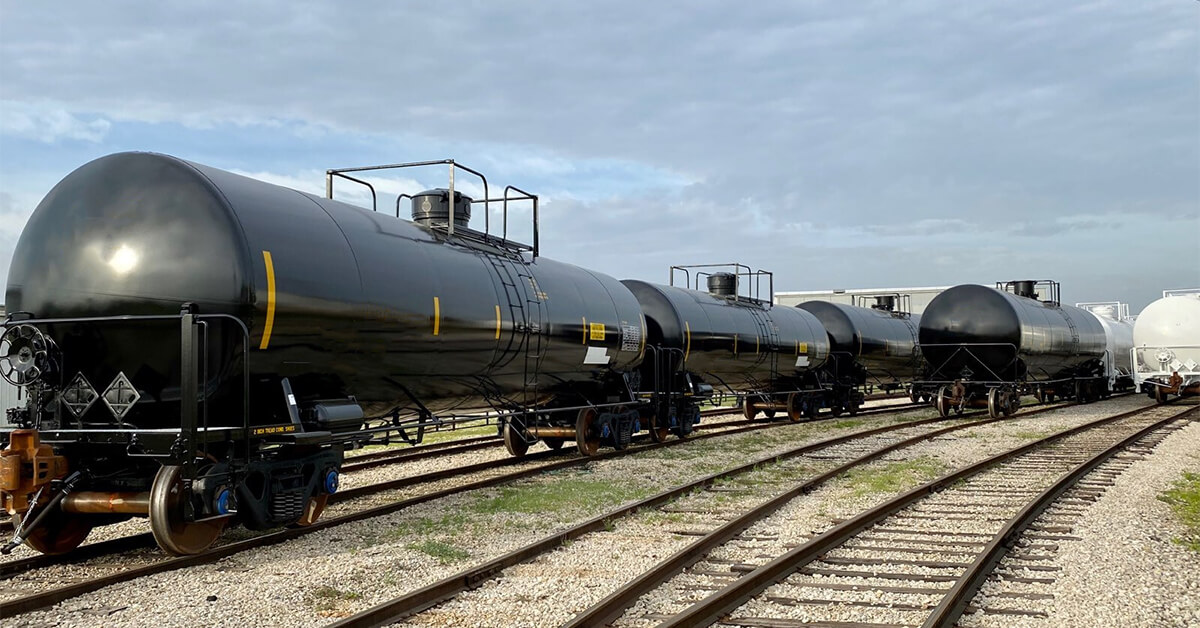
The right exterior railcar coating keeps rolling stock on the rails as planned. The wrong one risks a premature and costly visit to the shop.
Perfection is impossible, but matching a coating technology to a fleet's service environment, performance expectations, and operational priorities comes pretty close
And coming pretty close is still difficult: With so many different exposures and coating chemistries to consider, you’re left with a long list of options, each with its own set of pros and cons.
Owners, lessors, and car shop personnel all benefit from the guidance of informed technical professionals who help weigh exposure conditions and performance criteria against cost considerations and shop circumstances.
The perfect solution doesn’t exist. What is “right” is relative. What you’re looking for is balance.
Analyze performance expectations
Service environment plays a critical role in determining the appropriate railcar exterior. However, environmental exposure requirements can conflict with longevity goals, short- and long-term maintenance cost expectations, and aesthetics.
Ask these fundamental questions before selecting a coating system:
- Exposure: Is the car subject to corrosive industrial atmospheres, humid coastal conditions, chemical exposure from commodities, or extreme weather? Hauling soybeans in the Midwest or salt along the Gulf coast are two very different scenarios.
- Service life: How old is the car? Is five to 10 years before next maintenance acceptable, or must it be 15 or 20? How well do your coating maintenance expectations align with the car’s 10-year requalification cycle? What you do this time around might be based on what you expect to do next time.
- Aesthetics: Is long-term color and gloss retention critical, or is corrosion protection the primary concern? What if the answer is ‘yes’ to both? This informs which coating technology to apply, and that influences the expected service life and project expense.
- Cost: Does your budget allow for the higher up-front cost that buys a longer-performing solution? Or does the coating just need to last until the next scheduled maintenance in a few short years?
Weigh the pros and cons
Considering the pros and cons of each solution propels the specification process. Polyurethanes, epoxies, and water-based acrylics remain the most specified exterior railcar coatings based on their proven performance across a range of service environments.
The following comparison outlines common coating technologies, typical service life expectations, and key advantages and limitations for informed coating selection
| Coating type and service life | Pros | Cons | Applicable solutions |
|---|---|---|---|
| Epoxy 10-20 years |
|
|
|
| Polyurethane 15+ years |
|
|
|
| Water-based acrylic 10+ years |
|
|
|
| Alkyd 10+ years |
|
|
Evaluating long-term value
For most fleet managers, cost and service life are the primary factors influencing coating selection. While railcar requalification intervals vary depending on commodity and service conditions, coating performance is often evaluated against a 20-year service horizon. Despite this, most coating decisions are based too heavily on today’s price per gallon while overlooking total lifecycle cost.
While a lower sticker price appears attractive, factors such as service environment, exposure severity, maintenance frequency, labor requirements, and downtime can quickly offset initial material cost savings. Viewed through this lens, the lowest-cost exterior is not always the most economical option.
Hypothetically, comparing an epoxy coating that costs $29 per gallon and requires a repaint every 10 years to an epoxy coating that offers a 20-year service life at $40 per gallon provides mathematical proof of cost savings.
- Railcar A (10-year service life): 10 gal x $29 per gal x 2 applications = $580
- Railcar B (20-year service life): 10 gal x $40 per gal x 1 application = $400
Over the 20-year period, railcar B results in $180 in material cost savings, excluding additional labor, downtime, and logistical costs associated with a recoat. With these factors considered, solutions that offer longevity at a higher price provide greater overall cost savings.
That theoretical example is true to life but also simple. Others are more complicated. Service schedules, inspection intervals, damage risk, and asset strategy all influence coating selection.
Suppose a rail car requires maintenance painting sooner than anticipated. Do you choose a shorter-lived, economical option to tide the car over until a higher-performing material can be applied during the next requalification? Or do you invest in a longer-lasting material now so that you can skip coating entirely the next time the car is in the shop? The situation is probably best addressed case by case based on the car’s age, where it travels, its commodity, and other factors.
Ownership also shapes coating decisions. Entities that own railcars outright may prioritize extended service life and reduced long-term maintenance, while leasing entities could focus on coatings that protect assets through a defined lease term and requalification cycle.
Evaluating coating performance in the context of requalification schedules, anticipated damage, service environment, and ownership strategy helps fleet stakeholders to select systems that make sense in real operating conditions.
Proven performance across coating chemistries
Field-proven performance reinforces the cost-versus-lifecycle approach. One documented example is the use of alkyd-based Carbocoat® 8215 as an overcoat system on an existing epoxy coating, providing long-term exterior protection for a fleet of railcars in plastic pellet service along the East and Gulf Coasts. Despite prolonged exposure to coastal conditions, the fleet exhibited minimal visible weathering after more than 15 years of service.
While not all alkyds would perform at this level, this case illustrates how, under well-defined service conditions, certain coating technologies adequately balance upfront material cost with long-term durability.
Similar versatility is evident in epoxy and urethane technologies. In December of 2000, Carboguard 904 provided durable exterior protection on a then newly constructed hopper car operating in a moderate industrial and chemical environment. After approximately 15+ years of service, technicians observed good appearance and minimal rust bloom.
Coating selection is equally critical in new construction. Carbothane® 8845, a high-build acrylic polyurethane, was applied to newly constructed railcars owned by a major leasing company. Its high-build, direct-to-metal characteristics supported efficient single-coat application while delivering the exterior durability required for the intended service environment.
Whether applied during maintenance cycles or specified for new construction, these examples demonstrate how a careful analysis of service environments and exposure conditions supports informed, practical specification decisions.
Expertise delivers better solutions
There is no single "right" coating choice that fits every fleet. Evaluating service conditions, maintenance cycles, and performance requirements allows rail asset stakeholders to move beyond one-size-fits-all decisions and select systems aligned with real operating needs.
The strongest outcomes emerge through an informed analysis that draws equally on fleet professionals’ practical knowledge and coatings experts’ technical guidance.
Ultimately, professional collaboration is key in choosing the "right-for-you" solution.