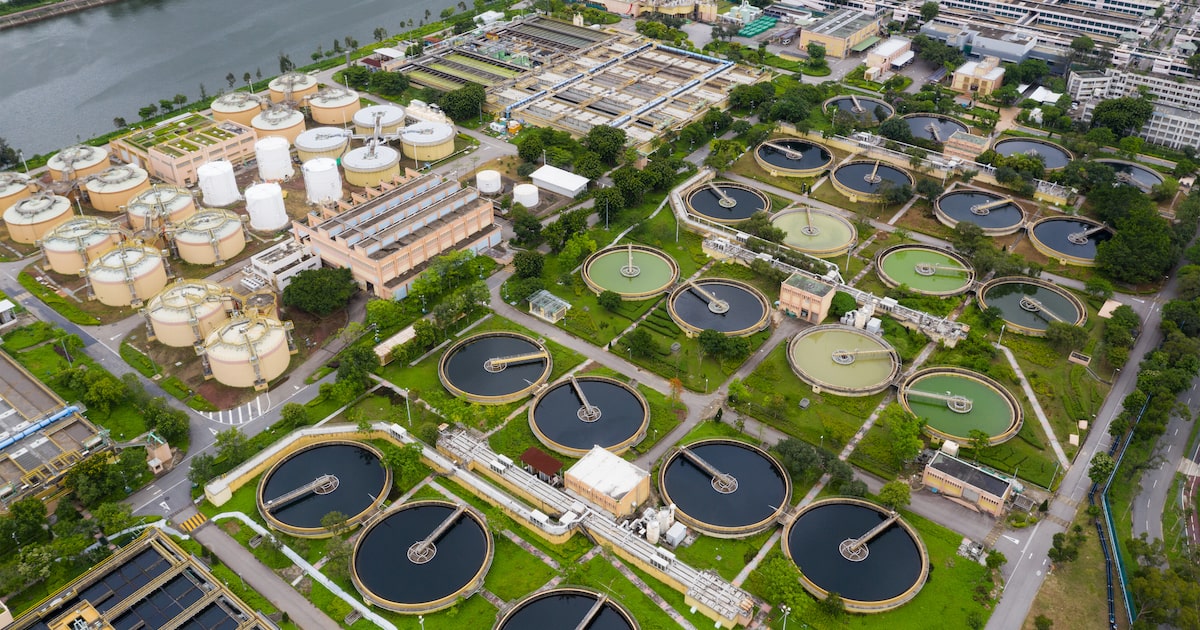
Water and wastewater systems rely on complex structures and processes that encounter demanding conditions and can prove difficult to repair. These conditions also leave critical assets vulnerable to corrosion, a major cause of degradation across water and wastewater infrastructure.
Main sources of water/wastewater infrastructure corrosion:
Understanding how each type of corrosion forms provides the first step toward interrupting the process or stopping it before it starts.
Microbial corrosion
Microbial corrosion, also called microbiologically influenced corrosion (MIC) or biogenic corrosion, involves microorganisms associated with the sulfur cycle that attack unprotected concrete.
In a common wastewater pathway:
- Sulfate-reducing bacteria produce sulfides in submerged or anaerobic areas.
- Sulfur-oxidizing bacteria convert those sulfides into sulfuric acid in moist, oxygen-rich areas above the waterline.
- The resulting low-pH environment attacks unprotected concrete.
Microbial corrosion can be detected and may not pose an immediate threat to a facility, but the longer it is left to fester, the greater the risk of an asset failure. If deterioration is observed, addressing it at the earliest possible opportunity will minimize the time the asset is out of service as well as the remediation cost. Resurfacing mortars can repair damaged concrete and restore the surface before a protective lining is applied.
Specifying a concrete lining from the start saves the most time, money, and labor later.
2. Galvanic corrosion
Galvanic corrosion occurs when dissimilar metals are electrically connected in the presence of an electrolyte. In these conditions, the more anodic metal corrodes preferentially to protect the more cathodic metal.
The corrosion rate depends on the following factors:
- The relative surface areas of the anodic and cathodic metals
- The type of electrolyte
- The concentration of salt ions
Galvanic corrosion can be limited by selecting compatible metals, applying a barrier coating, or separating the metals with an insulating material such as PTFE washers.
3. UV degradation
UV radiation is powerful enough to break apart the chemical bonds that form a protective coating, especially those in traditional epoxy coatings. Therefore, the typical exterior coating system including an epoxy intermediate also includes a UV-resistant, urethane-based finish that shields the epoxy.
The combination provides combined barrier and UV protection on elevated storage tanks or any surface in atmospheric exposure.
Common finish-coat technologies include:
- Fluorourethanes
- Polyurethanes
- Polysiloxanes
- High-performance acrylics
These coatings combine long-term exterior performance with the appearance expected of highly visible community assets.
4. Chloride-induced corrosion of rebar
Steel reinforcing bar improves concrete’s tensile strength, while the alkalinity of concrete creates a passivating layer around the embedded steel. But chloride ions present in wastewater can penetrate porous unprotected concrete and disrupt that passivation.
As the reinforcing steel corrodes, the rust it produces expands and exerts pressure on the surrounding concrete. This pressure can cause the concrete to crack and spalling to develop on the surface. At the same time, the reinforcing steel loses thickness. The combined result is a loss of structural integrity threatening asset performance.
Specifying a barrier coating helps prevent the ingress of chloride ions throughout the concrete.
5. Concrete carbonation
Concrete’s porosity can cause problems in atmospheric exposure as well as under immersion. If carbon dioxide or carbonate ions in the atmosphere diffuse into concrete, their reaction causes a lowering of the overall pH levels.
This also disrupts the passivation of steel reinforcement, and a similar chain reaction leading to a loss of structural integrity can occur. A simple effort to protect the concrete structure with an adequate barrier coating can diminish this cycle’s occurance.
6. Physical forces
Coatings and substrates may also deteriorate through physical forces such as:
- Freeze-thaw cycling
- Abrasion and erosion
- Impact damage
- Scouring from sand, rocks, and other debris
- Contact from cleaning equipment
A fit-for-service protective coating or lining must withstand both the environment and the physical demands of the asset, and is the easiest way to protect against this type of corrosion. Lean on coating manufacturers and experienced contractor partners to specify the protective solution best tailored to your specific environmental and process conditions.
Understanding is the first step to prevention
Understanding the types of corrosion and how they develop gives you the tools needed to stop corrosion once it starts, or fight against it before it starts at all.
Whether protecting new construction or rehabilitating an existing asset, protective coating and lining systems offer a cost-effective way to combat corrosion in water and wastewater environments. Although these systems involve upfront costs, they can reduce the far greater costs of diminished service life or total asset replacement, making corrosion prevention a worthwhile investment.